Tuesday, January 06, 2009

The La Sirena necklace...

"Sirena" is an Italian word that means "Mermaid". I was once again inspired by the South of Italy, and the blue waves and swirls of an imaginary sea where mermaids might certainly be found.


For La Sirena I used...

- One silver-foiled long Murano focal bead with aqua swirls;
- Six medium Amazonite beads that I brought from Brasil last time;
- Four long Czech glass creamy aqua beads;
- Ten Czech crackled glass aqua rondelles;
- Several Swarovski bicones in different sizes;
- Six lovely but very fragile fluorite beads;
- Two round silver-foiled aqua Murano beads in the same design as the focal one;
- Stardust silver-plated round spacers (between the fluorites) and Silver Heishi spacers between the Amazonites;
- Two elliptical silver-plated beads;
- Several tiny silver-lined Czech glass beads;
- Silver-plated Tibetan clasp with a complimentary design.

Some close-ups, as usual...


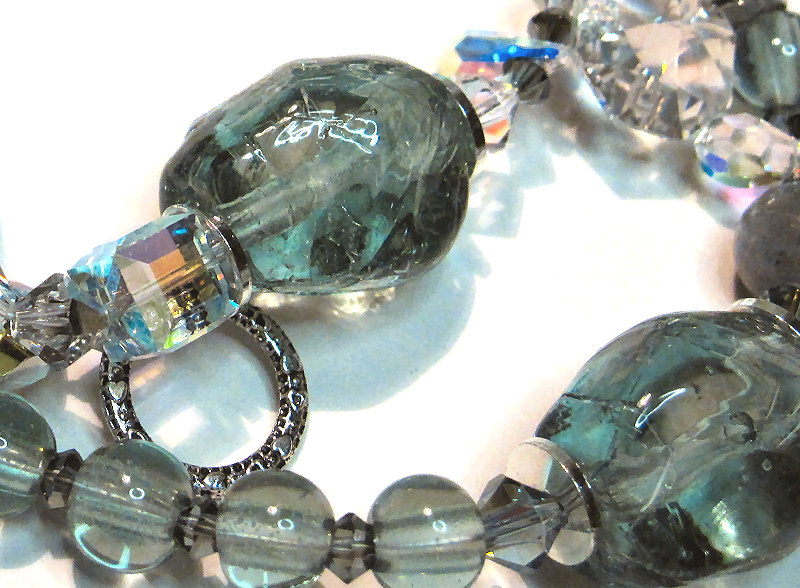
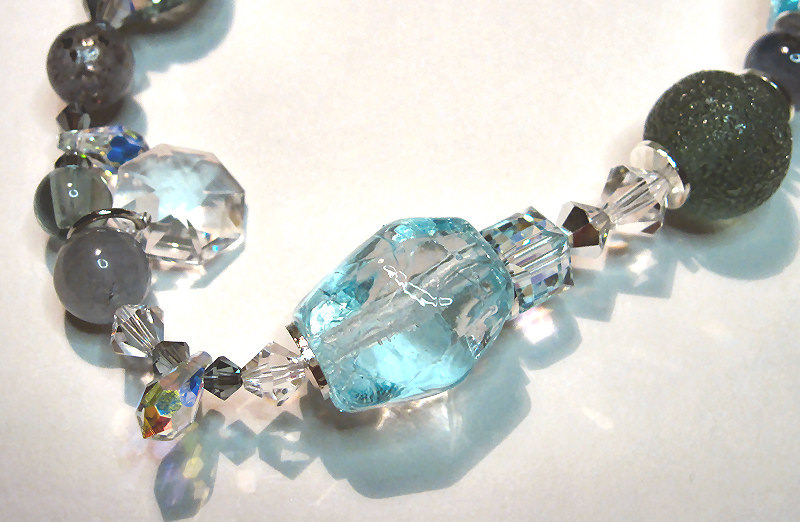
The focal Murano bead...


One of the round Murano beads, also with the swirls (or spirals) as in the main bead, and the fluorites. These are of a lovely, extremely pale shade of green/blue, almost clear. Actually, the colour is barely detectable. As I mentioned before, they are very breakable and fragile, so, extra care is required when handling this necklace. However, that must be said of ANY glass necklace - not only this one! Between the fluorites, you can have a peek of the stardust tiny balls and, immediately underneath, the aqua crackled Czech rondelles, intertwined with some Swarovski bicones.


A detail of the Amazonite beads, flat Heishi spacers and one of the Tibetan silver beads in the shape of a tiny rose and surrounding the focal piece. And on the right, a close-up of the clasp, which has pretty much the same design as the Murano main pieces and would represent the waves , erm, quite well... No?... I also added some rose beads to the ends of the wire and before the clasps. I think it gives a nice finishing touch and reinforces the structure as well.

Labels: ,

Sunday, January 04, 2009

The Kaeru no Uta necklace...

The necklace I made today is called Kaeru no Uta, which, in Japanese, means "Frog Song". I made it mostly because my Mother LOVES frogs, and I managed to put my hands on some really lovely Chinese lampwork pendant beads, with super-cute frogs over a leaf. They are very delicate though, and should be handled with extra care.

In Japanese though, Kaeru not only means "frog", but is also a verb, meaning "to return". So, little ceramic frogs tucked inside your purse are meant to bring good luck, and a safe return home. Or even, money! In that sense, they are somehow linked to things or people coming back to their places of origin, even if only by a simple play on the words. It is said that if you have a frog around, it will indeed bring the good things back: friends, money, and so on...

Frogs are also linked to the Summer, and the rainy season in Japan.

Here is my Kaeru no Uta:

For this necklace I have used:

- One Chinese lampwork focal bead in the shape of a leaf with a cute frog grabbing it;
- Small Red Sea coral beads;
- Two big jade beads and two medium ones;
- Several aqua and dark green with black stripes dragon vein beads;
- Some few blue goldstone beads;
- Tiny red Swarovksi bicones;
- Six vintage Czech fire round beads with blue opalescence;
- Tiny faceted Czech fire beads in metallic, iridescent shades;
- Small gold-plated and bronze-plated stardust spacers;
- Antique gold bead caps and clasp in the shape of a leaf.

Follow some close-ups...


On the 1st picture a detail of the lampwork pendant. Note the back of the frog has some gold foil speckles, very pretty and delicate. His tiny toenails are painted blue, which may be the tendency for Spring-Summer, no? You can also see the two small Red Sea coral beads that I used as an accent. Between them, I placed two stardust balls, in order to support the pendant and cover the wire. But they are not visible.

In the middle picture, the green dragon veins (teal and dark green) are visible, along with one jade bead at the top (light green) and the blue sandstone beads. These beads have a light golden dust effect that is not quite visible in the picture, pretty much as if they were oiled and then submerged into gold/copper powder. Goldstone is actually a man-made gemstone, not natural, and produced by adding copper salts to glass, inside a furnace. These salts (copper) are responsible for its star-shine characteristic. The gold-plated bead caps can also be seen here.

On the 3rd one, a detail of the tiny Czech fire faceted beads, and right underneath, three of the Vintage round Czech beads. The red bicones, one coral bead and some of the stardust spacers are also visible.


On the left, detail of the back of the lampwork pendant and two of the coral beads, along with those lovely blue toenails! And, on the right, two big jade beads and some of the others (goldstone, dragon veins, coral).


On the left, we have another view of the different Czech beads I used, the small stardust spacers, coral beads and Swarovski bicones. On the right, a detail of the leafy antique gold clasp and some of the stardust spacers I used in both ends.

And, to end this post, a view of the back of the necklace, showing the lampwork pendant and also the back of the clasp...

Labels: , ,

Saturday, January 03, 2009

The Ryu necklace...

I made this necklace tonight, really excited about the ojime beads. This time, it is also a round one, but with a lovely Dragon carved. For this reason I called it Ryu, which means "dragon" in Japanese.


For Ryu, I used:

- The ojime focal bead;
- Several Swarovski bicones in different sizes and shades of red and clear beige;
- Four Chinese golden cloisonée beads;
- Two glass pearls wrapped in golden mesh;
- Four Japanese wooden beads;
- Some Czech fire faceted small beads and Chinese glass pearls in powdered almond;
- Antique gold spacers, bead caps (only for the ojime) and S-hook clasp.

Here are the close-ups:


On the 1st picture, we can see a detail of the ojime bead, measuring less than 1 inch and very detailed. A little dragon with scales and beady eyes! The bead caps are also visible, as well as the copper crimps I used to prevent them from running while working on it, and which also compliment the overall look and colours. On the 2nd one, a detail of the new S-hook clasp, antique gold (plated), and very easy to handle.


On the left, you can see a detail of two of the cloisonnée beads used, the faux peral with mesh wire, some Swarovski bicones and Czech faceted crystals and another small glass pearl, almond-coloured in the right upper corner. On the right, another detail of the cloisonnée beads and Swarovski bicones.

Labels: ,

Friday, January 02, 2009

The Chuu-chuu necklace!

Happy New Year! My 1st post for 2009! Holidays have been hectic, as they are supposed (and expected) to be, and I did not have much time for posting or making necklaces. But I will re-start today, and hope to make much more nice things in 2009!

Today's necklace was more or less based on my previous Mori. I almost called it Mori 2, but then I looked at the focal bead and it was so cute that I changed my mind immediately. It is an Ojime bead in box wood, with little mice and leaves carved in. I even thought I might call it Mori no Nezumi (Forest Mice), but then again, I thought it might require a cuter name.
Then I came up with Chuu-chuu. "Chuu-chuu" is the Japanese onomatopoeic word for the sound mice make (which I think of as being "kee-kee"!). Also, it has to do with the little bat in the animated series "Rosario + Vampire", who always makes that squeaky sound at the end of the episodes or, well... Whenever he wants to, really!

The main piece here is the central box wood Ojime bead, which is hand carved and inspired by the ancient Japanese ojime beads - which were mostly made of ivory years ago (long before the ban). These beads are intended to work along with netsuke and inro boxes, as a way to hang items to the kimono sash (or obi). The inro boxes are the equivalent of mini-pouches/pochettes, where you would carry cosmetics, tobacco, money etc. They would hang from silk braids attached to the obi or obijime. The Ojime beads would help to keep the silk braid intact, so it would not frail. The netsuke, in the other hand, would close off the end of the silk cord.

Here is a detail of my ojime...

It is indeed very detailed and intricate, measuring no more than 1 inch. The eyes of the little mice have tiny beads embedded, as you can see here, very lovely.

For Chuu-chuu I have used as well:

- One focal Ojime bead as I babled about before!
- Swarovski bicones and round beads in Dorado. The round ones can be seen in the above picture, surrounding the Ojime;
- Six medium-sized jade beads;
-Two medium-sized dragon veins rondelles;
- Two green-striped round agate beads;
- Four small jade rondelles surrounding two flat oval dragon veins in shades of green-black;
- Six smooth round amazonite beads;
- Brown Czech faceted small beads;
- Some few gold-plated round small spacers and antique gold toggle clasp in a lovely flowery (leafy?) shape.

Some close-ups:


On the 1st picture, a close-up of the clasp I used and some of the gold-plated spacers. In the centre, you can see one of the oval dragon vein beads, a small jade rondelle, the green-stripe agate and part of a dragon vein rondelle. On the 3rd picture, a detail of the lovely Amazonite beads, in shades of blue, green, yellow, beige. All very earthy.


On the left, you can have a detail of the green-striped agate ball and the Swarovski bicones, and also one of the dragon vein rondelles. And, on the right picture, the bicones once again, placed between the jade beads.

And, to finalise this post tonight, the Chuu bat from Rosario + Vampire. Note one of his functions is to cover any shots of the girls' pantsu (aka, panties!)...

Labels: , ,

Tuesday, December 23, 2008

The Mizu no Hana necklace...

This is a green necklace, or rather a blue-green one. I decided to call it Mizu no Hana, or "Water Flower", flower from the water. Another necklace of Japanese inspiration. When working on it, I thought about lotus flowers, pearls and a peaceful, Zen-like, Japanese landscape.
I have used for Mizu no Hana:

- One green aventurine carved rose;
- Two large green crystal pearls and two medium ones;
- Several Swarovski bicones and two round Swarovski faceted beads;
- Rice-shaped dark green freshwater pearls;
- Czech dark green iridescent bugles;
- Tibetan silver clasp;
- Silver-plated round spacers and bead caps.

Some close-ups:


On the left, we can see the back of the carved rose, where I had to use two cloudy jade beads to hide the wire, as well as one crimp to keep the beads from running while working on it. On the right, one of the big pearls is visible, along with a very ornate silver-plated bead cap, with garlands of flowers, very pretty. Swarovski bicones of different colours, silver-plated spacers, Czech bugles and one jade bead are also visible here...


On the left, a detail of the jade beads, some Swarovski bicones and small filigree silver-plated caps. The other picture shows the lovely fresh water pearls and some of the small silver spacers.

And a final view of the necklace -rolled-up, the way I like!

Labels: ,

Wednesday, December 17, 2008

The Strega necklace...

I made another necklace tonight. I was dying to use some of my new dragon veins beads. Then I remembered that Mark once said I should make something really gothic, very, very dark. Dragon veins are ideal for that kind of thing due to their variety of colours and a very peculiar texture that really resembles a reptile's skin. Or indeed the veins of some magical beast.

I decided to call it Strega (which means "Witch", in Italian). I also had in mind some books by Carlo Ginzburg, Italian historian, notably the brilliant "Ecstasies. Deciphering the Witches' Sabbath", which I read years ago and enjoyed a lot. I was thinking about revisiting it perhaps. All related to witches and gothic, magical stuff, so there you go.

This is Strega then:


I have used:

- 14 bat wings;
- 7 frog nails;
- The tongue of a basilisk;
... oooops, not really!

Seriously now. This is what I REALLY used (easier to find than the above):

- One purple dragon vein agate focal bead, disc-shaped and very pretty;
- Several Swarovski bicones and two small pendants (also Swarovski);
- Four round dragon veins beads also purple;
- Four big dichroic glass beads;
- Two black onyx round beads;
- Two Czech Fire faceted beads;
- Swarovski crystal pearls of different sizes;
- Twenty small obsidian beads insterspaced with silver-plated crimps;
- Some very few silver-plated balls;
- Tibetan silver clasp (my favourite kind).

Some close-ups:


On the left, we can see the dragon veins focal bead. The "veins" are very strong, very marked. Above, a little detail of the obsidian beads and seilver crimps. On the right, we have one of the dragon veins beads and one of the dichroic ones, as well as some Swarovski black pearls and amethyst bicones.


On the 1st picture a detail of the Swarovski bicones and pearls, and obsidian beads. On the 2nd one, the clasp, a S-hook in Tibetan silver. They are very secure and look quite nice.

Labels: ,

Sunday, December 14, 2008

The Koyo necklace...

As Hanami (viewing of the cherry blossoms) is for Spring, so is Koyo ("colourful leaves") for Autumn. Viewing of the Autumn colourful leaves, is what the name means.

Then, I made my Koyo necklace today, inspired by this seasonal ritual. Main colours are reds, golds, maple shades. It is quite heavy due to the amount of gemstones I decided to mix here:

For Koyo, I have used:

- One Murano focal bead with gold foil;
- Several antique gold plated bead caps and small beads;
- Six red jade beads;
- Four fire agate orange beads;
- Four beige/brown jade beads;
- Two orange turquoise beads (probably man-dyed);
- 2 faceted rubies;
- Fourteen goldstone beads (also called aventurine or sandstone);
- Golden crimps in-between the goldstones;
- Two heart-shaped Chinese lampwork beads;
- Czech fire faceted crystal beads and AB (Aurora Borealis) bicones;
- One of my favourite clasps, a copper leaf.

Some close-ups...


The 1st picture shows the Murano focal bead in detail, with gold foil and a red rose swirl. The 2nd one shows some of the gold-plated spacers, some Czech Fire faceted beads and one dark red ruby surrounded by two bead caps in the shape of a leaf (or flower). I tried to vary the bead caps for different stones in the necklace, also to represent the variety of trees and leafs you can find in a single forest. They also look a bit like fallen leaves, due to their antique gold, copper hues. And, on the 3rd picture, you can see one of the red jade beads followed by a fire agate deep orange one. Other types of bead caps are also visible here.


On the 1st picture, you have a detail of the nice goldstone beads. Their lovely red brick colour derives from the amounts of mica and hematite present in their composition. They are insterspaced with tiny gold crimps, as I said before, and which are visible here. The 2nd picture shows one of the Czech AB beads, one red jade bead at the top, and further down, another fire agate bead. The 3rd one shows the copper leaf clasp.

A different view of the necklace here...


Slung over a screen,
a dress of silk and gauze.
The autumn wind.

Taniguchi Busan (1716-1784)

The Tartuffo 2 necklace...

I made this necklace yesterday and, since it is kind of similar to my previous Tartufo, I called it Tartuffo 2. I know, it's not quite an exciting name, but they are born of the same idea and made on the same day more or less, so...

Here it is. Note it is much shorter than the usual, since some people do prefer shorter necklaces. I personally prefer them longer, but I cannot make necklaces solely based on my personal tastes, so...

For the Tartuffo 2, I have used:

- 1 round lampwork paperweight pendant in shades of purple;
- 6 small purple chrysocolla beads;
- Swarocvski crystals;
- Tibetan silver spacers and clasp;
- Czech fire faceted beads;
- Czech glass beads in various shapes and cuts, including 4 really cute square ones.

Some close-ups as follows...


These pics show details of the lovely square Czech beads, Swarovski crystals and some of the Chrysocolla beads. You can also see some of the Tibetan silver lantern-shaped spacers, the tiny silver-plated balls and also one of the Czech fire faceted beads I used.


On the above, you can see again some of the Czech fire beads, spacers and chrysocolla beads, and also the S-hook tibetan silver clasp, which I quite like.


A detail of the Chinese lampwork pendant, paperweight style, some more of the chrysocolla beads and small silver Czech seeds. I use these to make a smoother curve where the pendant is, otherwise it might look a bit too "angular" and "broken". As you can see, the chrysocolla vary a lot in shade: these two - that I put closer to the focal point, ie, pendant - are pinkier than the others.

Finally, another view of the ncklace, this time also on a black background...

Labels: ,

Friday, December 12, 2008

The Tartuffo necklace...

This one has been inspired by food. The taste of black truffles. Italy again, up in the North this time. I think the colours try to convey a certain subterranean, underground quality that we associate to the truffles, or "black gold"...

For Tartuffo I used:

- 1 black and purple lampwork (paperweight style) pendant, probably Chinese;
- Under it, 3 or 4 small Czech seed beads to hold it in place and make a smoother curve;
- Small chrysocolla beads;
- Bigger dark amethyst beads;
- Tibetan silver spacers and clasp;
- Czech silver-lined bugles and opalescent beads in various shapes;
- Czech fire faceted beads;
- Swarovski bicones as accent beads.

As for the chrysocolla beads, I am not sure if they are 100% natural or man-treated, ie, dyed. They have for sure a nice purple colour (not entirely discernible in the shots, I'm afraid), but the texture is kind of rough. I have some green and blue ones in my stock here and, although they look beautiful, I don't quite like their texture, very heavy and harsh.

Some close-ups:


At the left you can see the lampwork pendant in detail, along with some tiny silver balls, lantern-shaped Tibetan spacer and two Czech fire faceted beads. In the right, a close-up of the seed beads used under the pendant. You can also see one of the chrysocolla purple beads.


Details of the Czech beads, Swarovski crystals and various Tibetan silver spacers.


The big amethyst beads, silver spacers and two of the chrysocolla beads. Also, the clasp, one of the accent Czech fire beads and silver-lined bugles.

Labels: ,

Thursday, December 11, 2008

The Amé necklace...

Amé means "rain" in Japanese. Although this necklace has no Japanese beads whatsoever, the beads I used (Czech fioratto beads, Swarovski pearls and bicones, Czech gold-foiled seed beads) all have a wet, watery feel to them. It is like a string made of water drops. Mark thought so, and I agree. After thinking about it as a rose water necklace, I could not but hear Mark's arguments about it: "it's rain, Andrea, rain".

It is indeed a "wet" piece. Amé, for my love of Japanese things and language.

For the Amé I have used:

- 3 Czech Fioratto transparent beads with gold foil;
- 2 small Czech Fire teardrops in Rosaline AB;
- Several tiny clear gold-foiled seed beads;
- Swarovski bicones in different shades of rose and 2 "dorado" ones near the clasp;
- Antique gold spacers and clasp;
- Swarovski pearls in cream rose;
- 2 pink jade round beads.

Some close-ups:


In the picture at the left-hand side, you can see one of the pink jade beads used, the tiny gold-foiled seed beads and one of the Rosaline drops. The other picture shows one of the main Czech fioratto beads, with the gold foil giving it a "wet" appearance, along with some of the bicones and, again, the seed beads.


Detail of some of the Rose AB bicones, and antique gold spacers. Also, the clasp used. Since Amé is much shorter than usual, I have added a gold-plated extension chain so it can be worn longer if desired.

Labels: ,